Regenerating Torvean Quarry, derelict since 1991, into Scotland's National Infrastructure Skills Centre, training 2,500+ people a year and creating local infrastructure careers pathways
Estimated Cost
£32,000,000
Full Project Details & Description
What do you want to do?
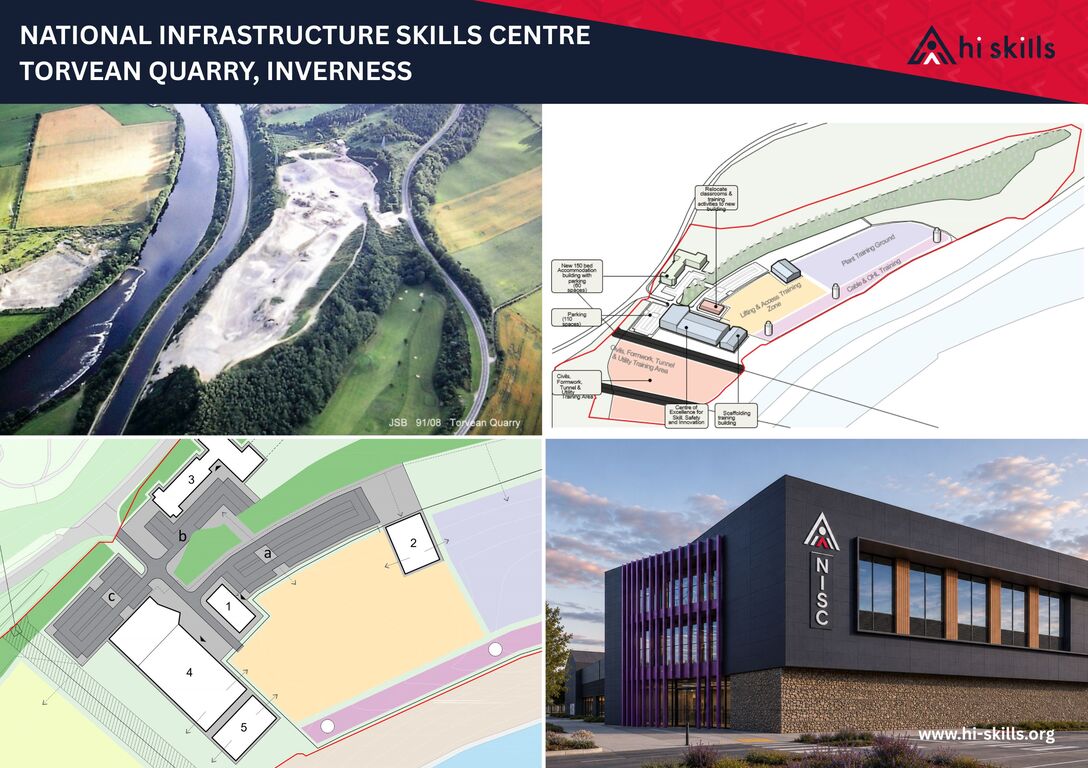
Highlands & Islands Skills CIC are seeking funding to progress the National Infrastructure Skills Centre (NISC) at the former Torvean Quarry, Inverness, a community-owned, industry-led facility delivering specialist infrastructure and renewables training not currently available in the Highlands, and in many cases not anywhere in Scotland. The 40-acre brownfield site has lain derelict since quarrying ceased in 1991. For 35 years it has sat unused and unmanaged, attracting unauthorised motorbike use, fly-tipping and antisocial behaviour, and has been associated with county lines drug activity, residents report fire brigade callouts to fires on site and near-misses between motorbikes and pedestrians on the canal towpath.
The activities we need funding for are: site remediation and clearance; enabling works including access, services and groundworks; and installation of Phase 1 modular training infrastructure, converting this long-standing derelict site into a nationally significant training campus, the only one of its kind in Scotland.
Why is our project important for our community?
HI-Skills is a not-for-profit Community Interest Company. There are no shareholders and no private profit extraction. Our constituted purpose is to benefit individuals and businesses across the Highlands and Islands who face barriers to accessing quality training and employment in civil engineering, construction, renewables and engineering construction, particularly in rural, remote and economically disadvantaged areas: young people, including school leavers and those not in education, employment or training; jobseekers, career changers and apprentices; underrepresented groups including women and ex-offenders; displaced oil and gas workers transitioning into green energy and infrastructure roles; and regional employers facing skills shortages. Under our CIC36 declaration, any surplus is reinvested into expanding training opportunities, supporting disadvantaged learners, and maintaining the facility for community benefit.
Scotland faces a severe infrastructure skills shortage: 18,291 new construction workers are needed by 2030, under-recruiting by around 5,220 annually (CITB Construction Skills Network Scotland). The nearest comparable specialist facility is a 1,000-mile round trip to south-east England, presenting a huge barrier to training with only a few dozen highlanders going there each year. Highland and Island businesses really struggle to access training, upskilling and apprenticeship delivery close to home, limiting their capacity, productivity and ability to compete for larger contracts. NISC puts high-quality training on their doorstep, allowing Highland employers to grow workforce capability and take on more and larger work, strengthening the regional economy, not only individual employment outcomes. NISC is being developed in direct partnership with industry including CITB (formalised through a signed MoU), and has engaged developers such as SSEN Transmission, contractors including United Infrastructure, Balfour Beatty, BAM UK & Ireland to name a few, MSPs and MPs across the political spectrum, and agencies including SDS and DWP.
The project directly delivers against the Inverness Strategy shared vision and Area Place Plan framework for the city including its priority outcomes of a living working city (450 apprenticeship starts and 2,500 learners annually, addressing the documented loss of young people leaving to find opportunity), a green and healthy city (remediation of long-derelict land and a low-carbon facility training the net zero workforce), and Inverness as a prime destination (a national-scale centre drawing learners to live, work and spend in the city).
Our community consultation (145 responses, 4-week engagement, 80+ event attendees) returned 94% support, with two-thirds of respondents (96 of 145) from the immediate IV2/IV3 area. Residents identified training and career opportunities for young people, local access to specialist training, and new jobs as the top benefits.
The positive impact our project will have.
National outcomes:
2,500+ people upskilled per year at Phase 1, closing a Scotland-wide skills gap currently served only by facilities 1,000 miles away, a conservative £3,500 earning uplift per person equates to £8.75m in added value annually.
A training pipeline aligned to national workforce strategy, supporting Scotland's infrastructure and renewables delivery capacity.
Regional outcomes:
Up to 150 foundation and 300 much needed modern apprenticeship starts annually. £6.24m in direct employment value each year.
Directly supports delivery of the region's tranformational opportunities, 250+ planned infrastructure projects worth over £100bn.
Places the Highlands as leaders in Scotland and even the UK for Specialist Infrasstructure, Construction, Engineering and Renewables training
Tackles rural and regional depopulation, a challenge well documented by Highland Council, HIE and Scot Gov, by creating opportunities and pathways into industry at home. Today, people must leave to train in specialisms in England and are then attracted to work there. Train here, work here, stay here.
Up to 50 FTE jobs at the Centre, with £1.8m in salary-based GVA over the first four years.
Increased productivity and competitiveness for Highland businesses through accessible upskilling, retaining training spend in the region rather than exporting it south.
Remediation of a site derelict since 1991, ending 35 years of fly-tipping, unauthorised use and documented incidents, saving Highland Council an estimated £12,500–£50,000 per year in waste removal and remedial costs.
A civic asset beyond training: community use of facilities outside core hours, partnerships with schools and veterans' groups, structured mentoring, and local procurement through third-sector partners.
All surplus reinvested into learner support, facilities and community benefit under HI-Skills' locked asset structure.
Our key milestones so far and what our next steps will be.
Community engagement and support evidenced: multiple consultations since April 2025, most recently returning 94% support.
Architects onboarded along with associated specialists to take us through planning and on to technical design stage (RIBA Stage4)
Outline site layout and building designs established.
Project plan/feasibility/business case created: full business plan completed, part grant-funded by HIE; Site Options Appraisal completed across five sites, with Torvean scoring highest and ultimately the only suitable site.
Necessary consents: Community Asset Transfer application submitted to Highland Council; planning pre-application and NatureScot pre-application engagement underway.
Quotes obtained: Phase 1 and Phase 2 fully costed; contractors engaged to deliver both phases.
Funding applications submitted: HIE grant support secured toward business planning; RCGF is one of a number of major capital applications, with match funding discussions live. Conditional industry sponsorship of at least £2.5m is secured, with potential for a further £9m of private investment, alongside signed MoU with CITB and ongoing engagement with HIE, National Construction College and industry partners including United Infrastructure.
Next steps: completion of the CAT process, finalisation of Phase 1 design, securing match funding, and commencement of enabling works.
RCGF support is sought specifically toward site remediation and Phase 1 enabling works, a defined capital package that unlocks a project already substantially backed by industry. This we feel is well within the scale RCGF routinely supports: recent rounds have awarded over £4m to single transformational projects elsewhere in Scotland. NISC offers Highland a project of equivalent national significance, with greater private leverage than most.
Our anticipated start date/end date.
Subject to CAT resolution and funding confirmation, enabling works are targeted to begin mid to late 2026 subject to the CAT, with Phase 1 operational within months of funding confirmation.
There is no end date by design. The National Infrastructure Skills Centre has a 30-50 year operational vision, its not a short-term project. It is a permanent regional asset intended to serve the Highlands and Scotland for decades, designed to flex and adapt to the specialist skills needs of future infrastructure, construction, engineering and renewables demands. Its community ownership and locked asset structure mean the facility and every surplus it generates, remains committed to that purpose for its whole life.
Wow!!! This is the sort of ambition we need in the highlands, long term employment, long term investment into the skills needed for the future here which will keep people especially kids in the region. 🙌🏻
.png)
Wow!!! This is the sort of ambition we need in the highlands, long term employment, long term investment into the skills needed for the future here which will keep people especially kids in the region. 🙌🏻